Best Warehouse Floor Coating for Forklift Traffic
For heavy forklift traffic, a high-build epoxy system with a polyaspartic or polyurea topcoat is the best combination — the thick epoxy base absorbs impact while the topcoat resists abrasion from tire scuffing and turning. Forklift-rated epoxy systems are specifically formulated for this and typically outperform standard commercial epoxy by years.
What Forklift Traffic Actually Does to a Floor
Forklifts create two distinct stresses: point-load impact from heavy loads and racking, and abrasion/scuffing from tires turning in place, which is especially hard on standard coatings at pivot points near racking aisles.
A forklift-rated system is built with a thicker epoxy base and a more abrasion-resistant topcoat specifically to handle both stresses long-term.
Get an industrial quote for your warehouse.
System Comparison for Forklift Traffic
| System | Forklift Durability | Cost per Sq Ft |
|---|---|---|
| Standard Commercial Epoxy | Moderate | $6–$8 |
| Forklift-Rated Epoxy | Excellent | $7–$11 |
| Epoxy + Polyaspartic Topcoat | Excellent | $9–$13 |
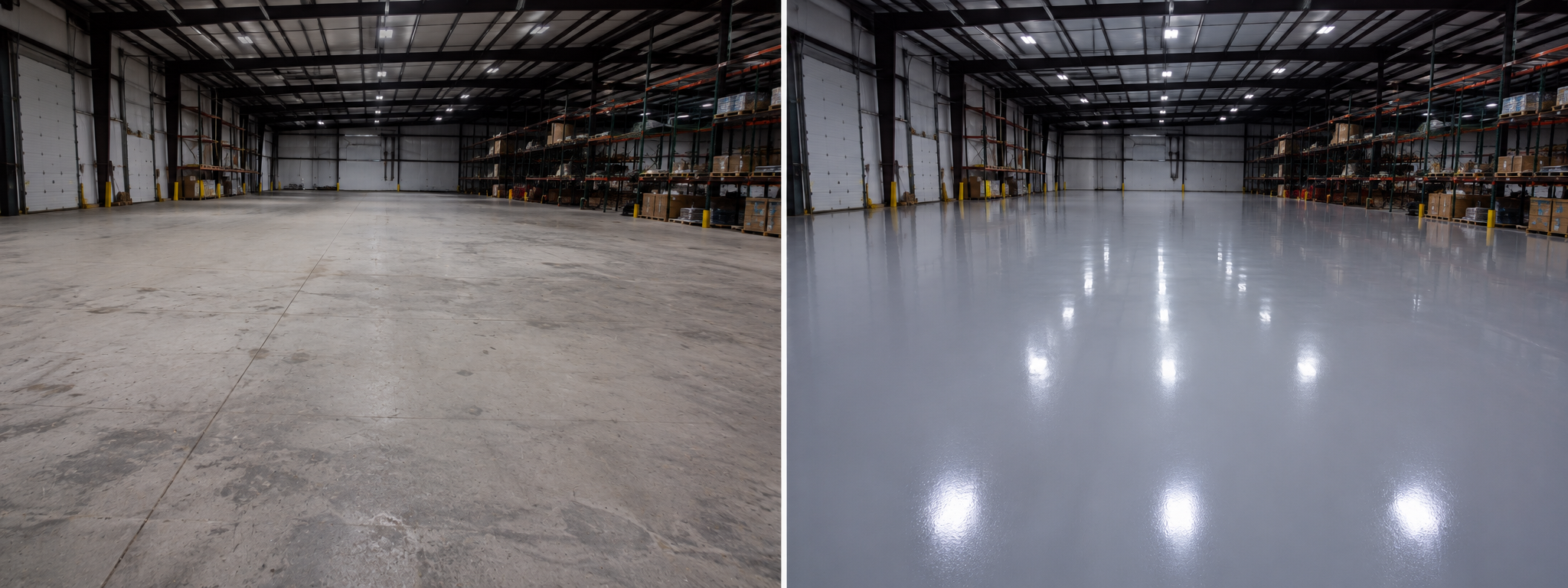
A distribution facility in Grand Prairie was seeing visible wear at every racking-aisle turn point after just two years on standard commercial epoxy. We reinstalled with a forklift-rated system and a polyaspartic topcoat specifically at high-turn zones — addressing the exact failure pattern they’d experienced.
Where to Prioritize the Upgrade
Not every square foot of a warehouse takes equal abuse. Racking aisles, dock approach areas, and turning zones near loading doors see the most wear and benefit most from a forklift-rated system or topcoat — open storage areas with less traffic can often use a standard commercial system to control cost.
- Racking aisles and turn points: highest priority for upgrade
- Dock approach and staging areas: high wear from repeated loading
- Open, low-traffic storage: standard commercial epoxy is often sufficient
See how other DFW facilities have handled forklift wear.
FAQ — Forklift Traffic Flooring
Best Warehouse Floor Coating for Forklifts FAQ
Request an Industrial Flooring Quote
We’ll assess your facility’s traffic patterns and recommend the right system for each zone.
4162 Peace Dr, Frisco, TX 75034
(469) 850-0660 — Call Center 24/7
Installs: Mon–Sat, 7:00am – 7:00pm
Resources
Residential
Commercial
Industrial